XP-C01 · G0
Lab workbench
Two things a napkin cannot fake: a residual that is honest about the instruments, and a heat map of the pipe that is not the geometric concentration. Both have to exist before anyone gets to brag about a coating.
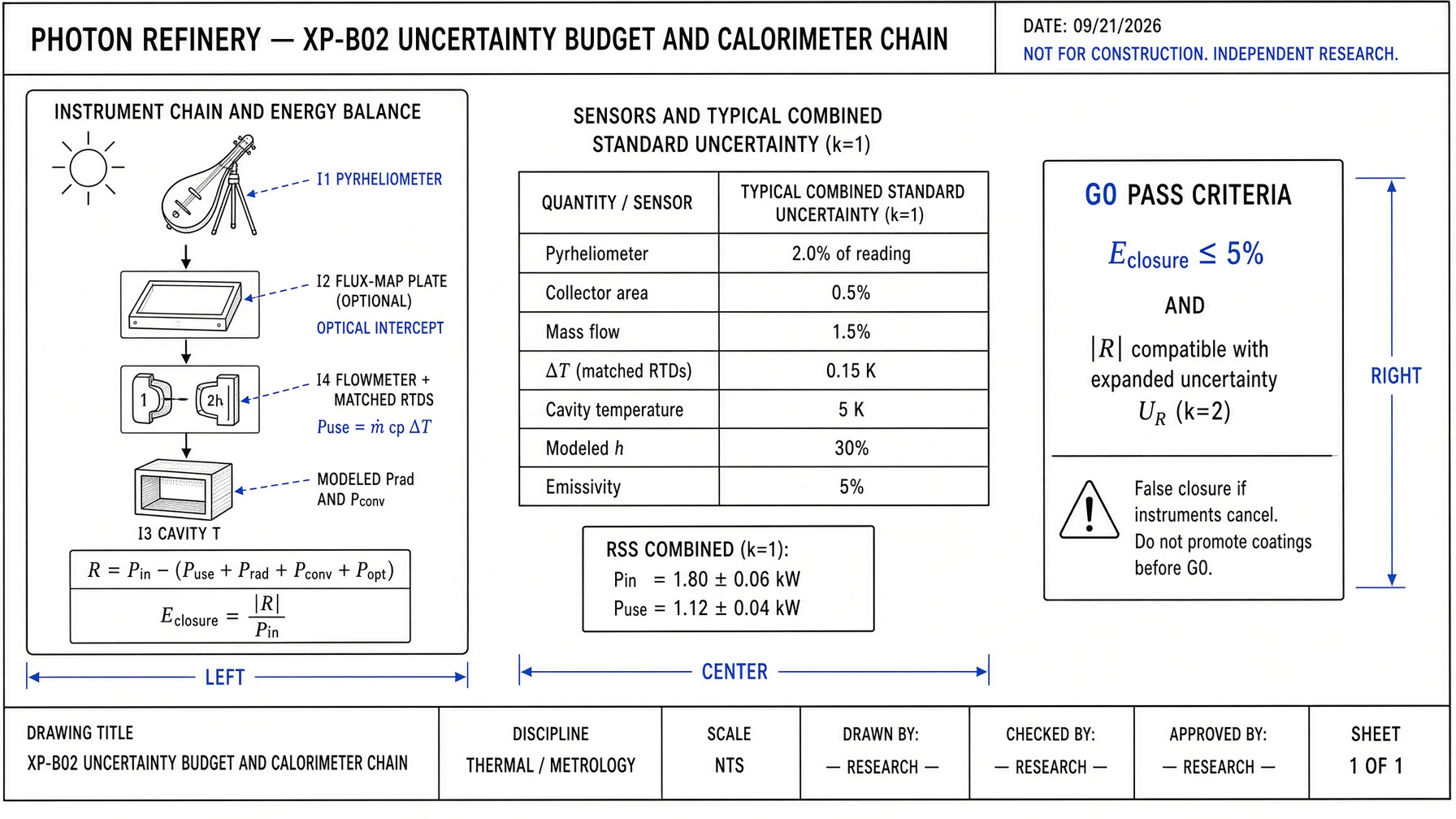
XP-B02
Uncertainty is first-class
Nominal watts are not a result. Report every power with a combined standard uncertainty, then close the residual against that budget.
1.80 ± 0.04 kW
Incident
DNI × Ac
1.12 ± 0.02 kW
Useful (calorimeter)
ṁ cp ΔT
0.00%
E_closure
|R| = 0 W
Opposite errors can cancel and still print a pretty E_closure. That is why |R| must sit inside the expanded uncertainty, and u_R itself must be small enough to resolve 5%.
Gate G0
Pass
- E_closure ≤ 5%yes · 0.00%
- u_R / Pin ≤ 5%yes · 4.02%
- |R| ≤ 2 u_Ryes · 2u_R = 145 W
XP-B03
Geometry is not flux
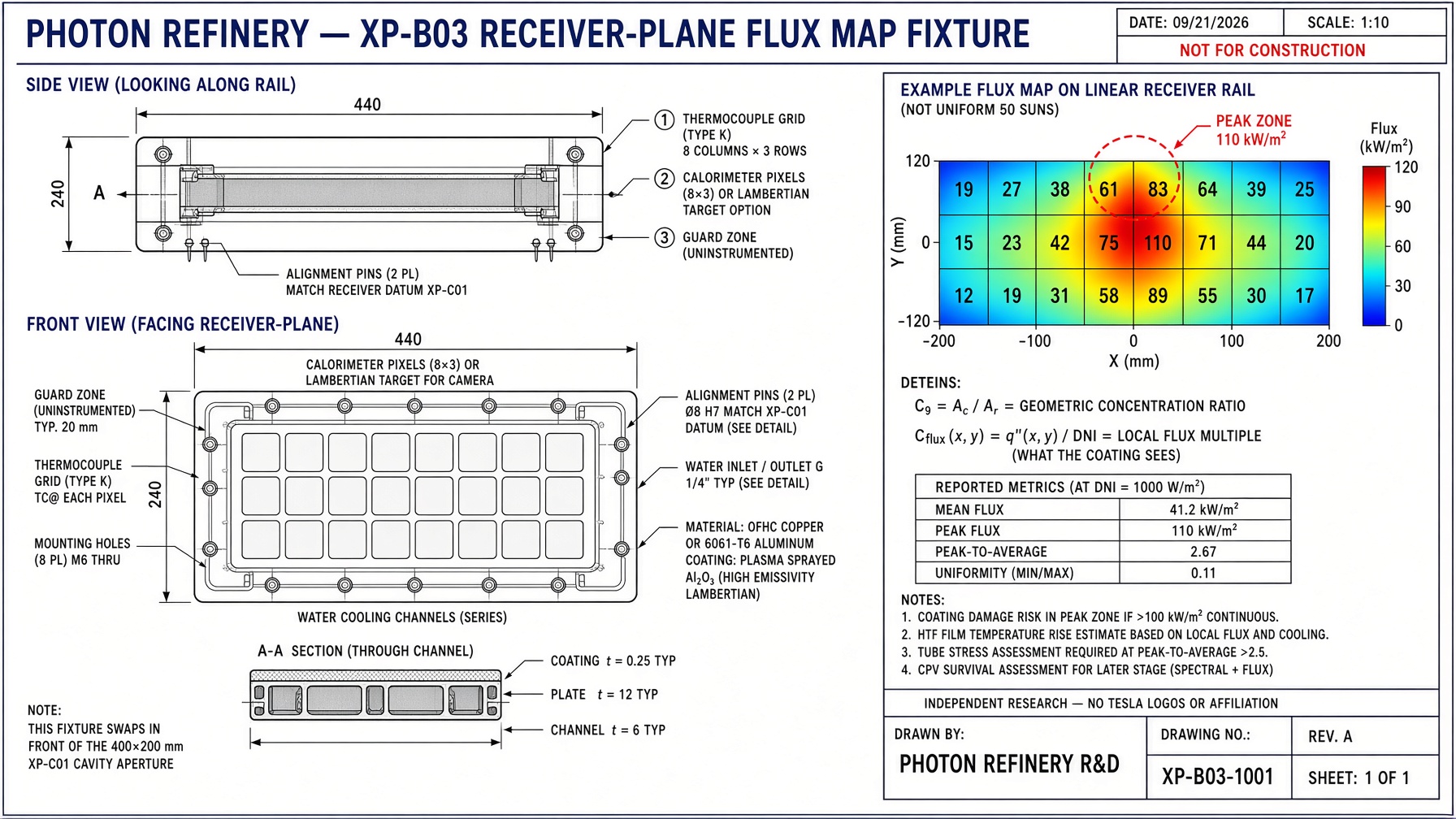
Cg = Ac / Ar sizes the aperture. C_flux(x,y) = q''(x,y) / DNI is the field the coating, the HTF film, and any later CPV cell actually occupy.
q'' in kW/m²
50×
Cg geometry
49×
C_flux mean
44 kW/m²
122×
C_flux peak
110 kW/m²
2.47
Peak / mean
Drives coating, film T, stress
A rail sold as 50× is not 50 suns everywhere. The example peak is 110 kW/m² against a mean near 40. That ratio is what kills selective coatings, cokes oil, and later decides whether a CPV stripe survives.