RC-T
FirstThermal baseline
Selective or black absorber, insulated cavity, heat extraction. Establishes optical and thermal balance with the fewest unknowns.
RC-T02
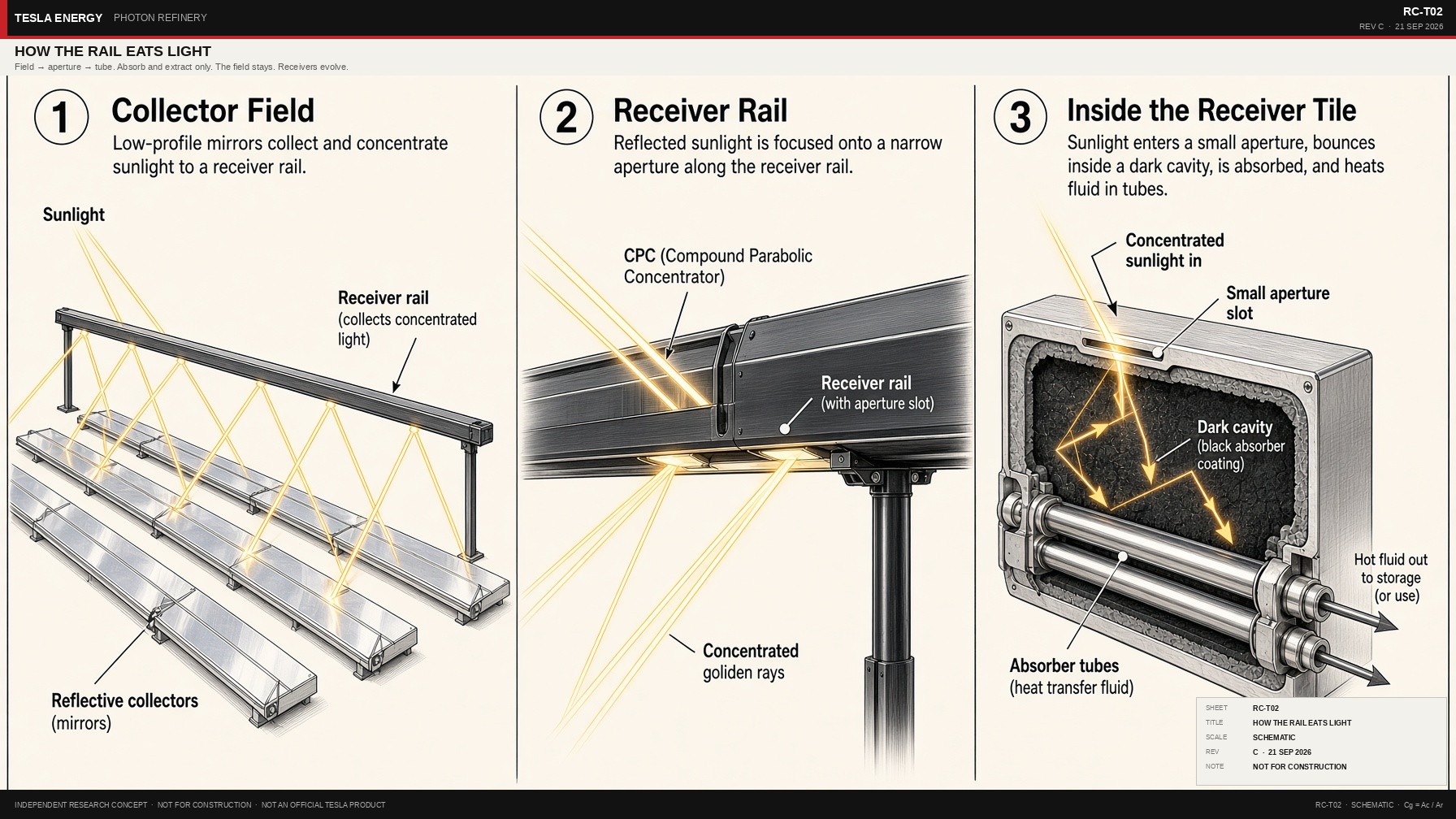
Cheap mirrors bounce the sun into a slot. The slot is a black box with two pipes of oil. Light becomes heat. Heat leaves through a hose. The mirrors do not move when you swap the box.
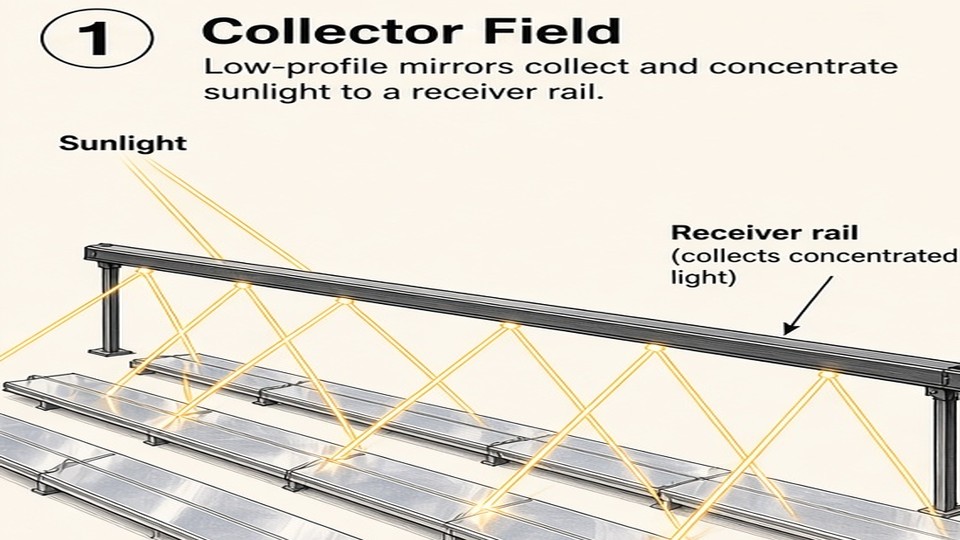
Cheap mirrors on the ground bounce sunlight up to a pipe. Nothing expensive lives in the dirt. If a sheet cracks, you swap glass — you do not rebuild the plant.
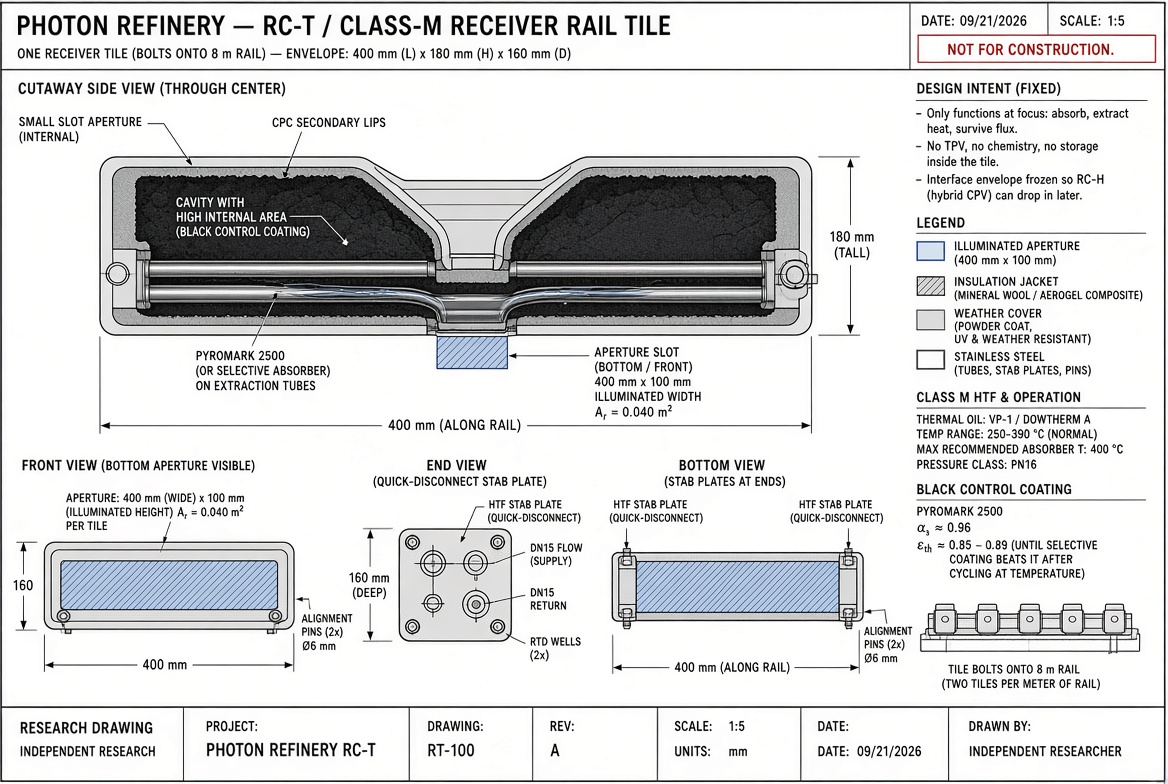
Tap a step. This is one 400 mm cartridge. Twenty of them make the eight-meter rail.
0.80 m² Ar
Cartridge
8 m run
250 → 390 °C
Hardware dump
η from the year, not noon
RC-T02
Same three pictures, drawn as a shop sheet. Field, slot, guts.
RC-T
Same box, different guts later. Only the parts that must sit in the beam belong in the tile.
RC-T
FirstSelective or black absorber, insulated cavity, heat extraction. Establishes optical and thermal balance with the fewest unknowns.
RC-H
After RC-TCooled PV intercepts useful bands; residual radiation becomes heat. Promoted only if net exergy gain survives cooling parasitics.
RC-P
AdvancedThermal cavity drives a wavelength-shaped emitter. TPV cells sit downstream, not inside the tile.
RC-X
ExperimentalResearch port. Not a project dependency. The plant survives if this never exists.
PR-C10
Hotter is not automatically better. Increase temperature only when added output quality exceeds added radiative, conductive, and material penalties.
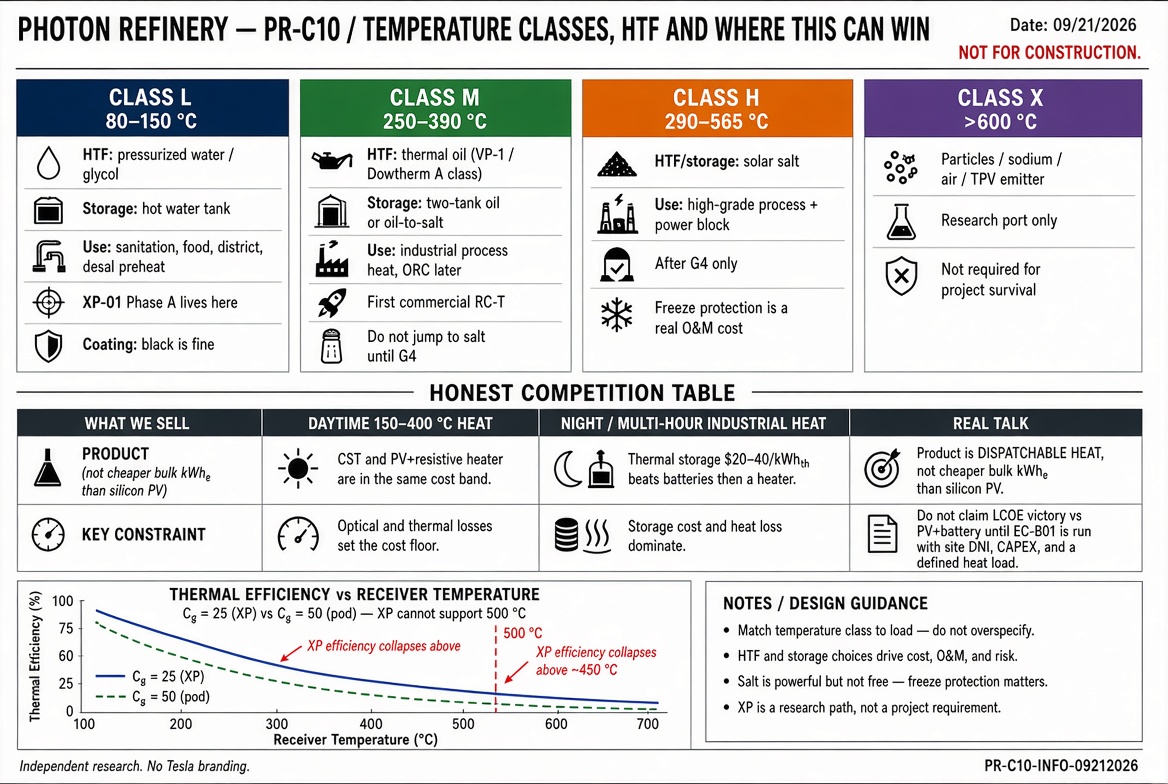
Class L
80–150 °C
XP-C01 Phase A lives here. Black coating is fine.
Class M
250–390 °C
First commercial RC-T. Do not jump to salt until G4.
Class H
290–565 °C
After G4 only. Freeze protection is a real O&M cost.
Class X
>600 °C
Research port only. Not required for project survival.