Tesla Energy · Rev C

Photon Refinery

Cheap mirrors in the dirt. Hot oil in a tank. Heat for a factory that already burns gas. The field stays. Receivers evolve. Use Plain or Nerd in the header — same plant, two languages.

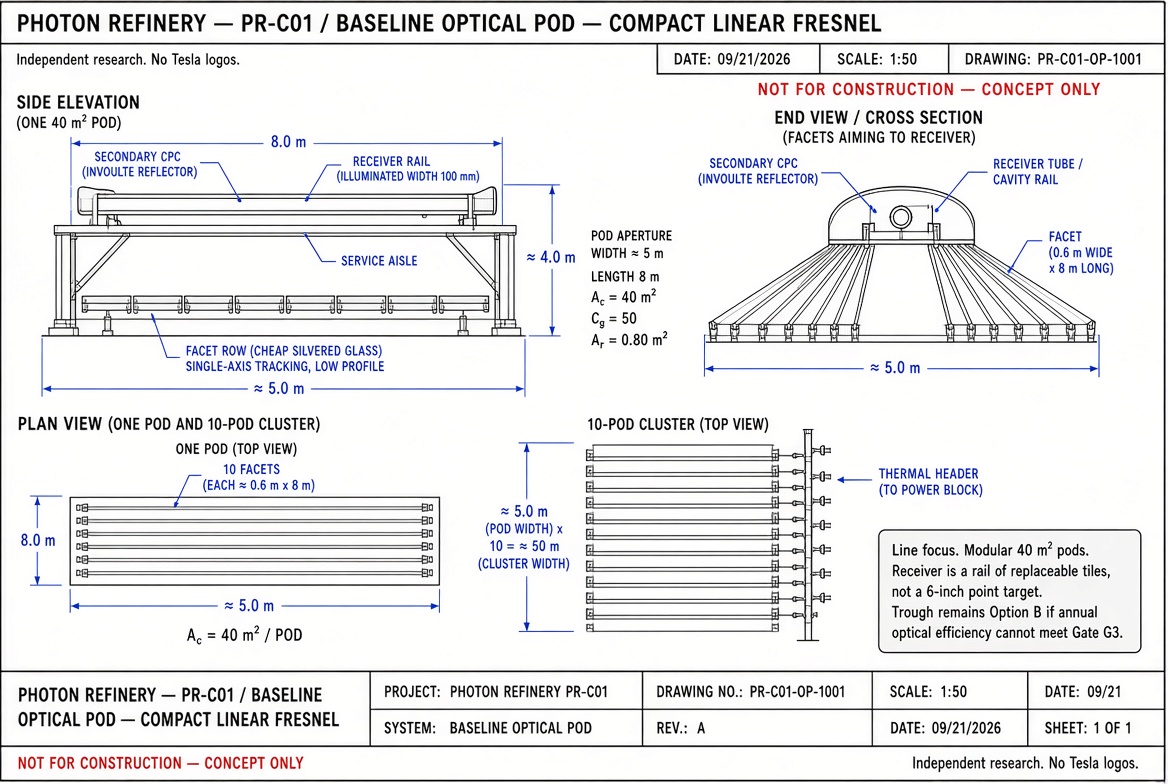
PR-C01 compact linear Fresnel pod blueprint

Architecture

Field stays. Receivers evolve.

  1. 01

    Collect

    Cheap optics. No semiconductor over the full field.

  2. 02

    Concentrate

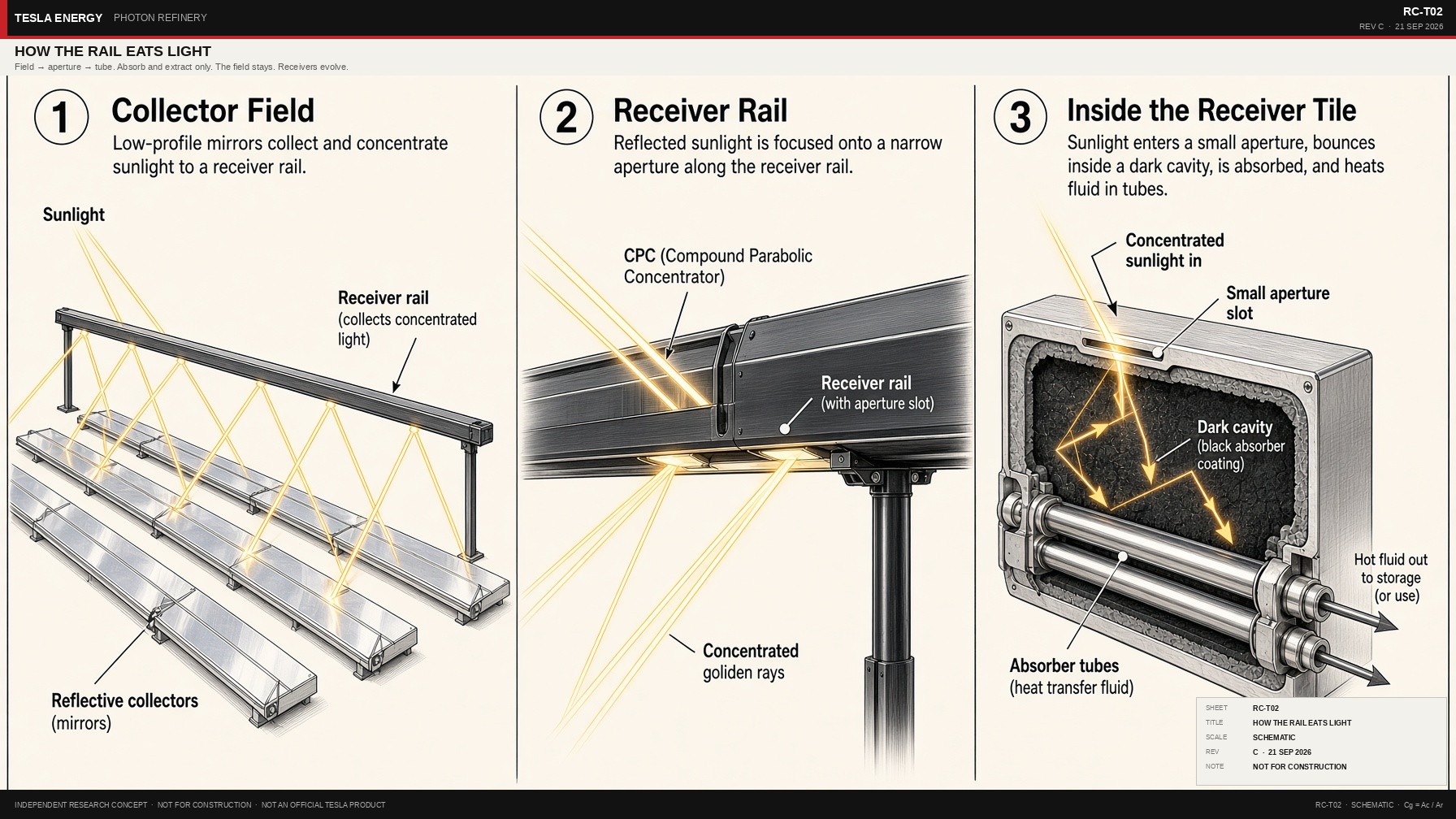
    10×–100× baseline. Size receiver from Cg = Ac / Ar.

  3. 03

    Route

    Receiver-defined. No unverified ultra-high flux target.

  4. 04

    Store

    High-grade heat. Decouple sun from dispatch.

  5. 05

    Convert

    Electricity only after it raises whole-system exergy.

2.6 acres

First island

120 pods, noon ~2 MW_th

~3.7 GWh

Yearly heat

West Texas typical year

~140 t

Tank oil

6 hours at noon

$/MWh_th

Scoreboard

Versus the gas they burn

Plain English

We are not trying to beat rooftop panels at cheap electricity. Silicon already won. We sell hot oil to factories that burn gas for 150–390 °C heat, and we store it so the line still runs when a cloud goes over. One pod is a house. A first plant is two and a half acres.
Lab

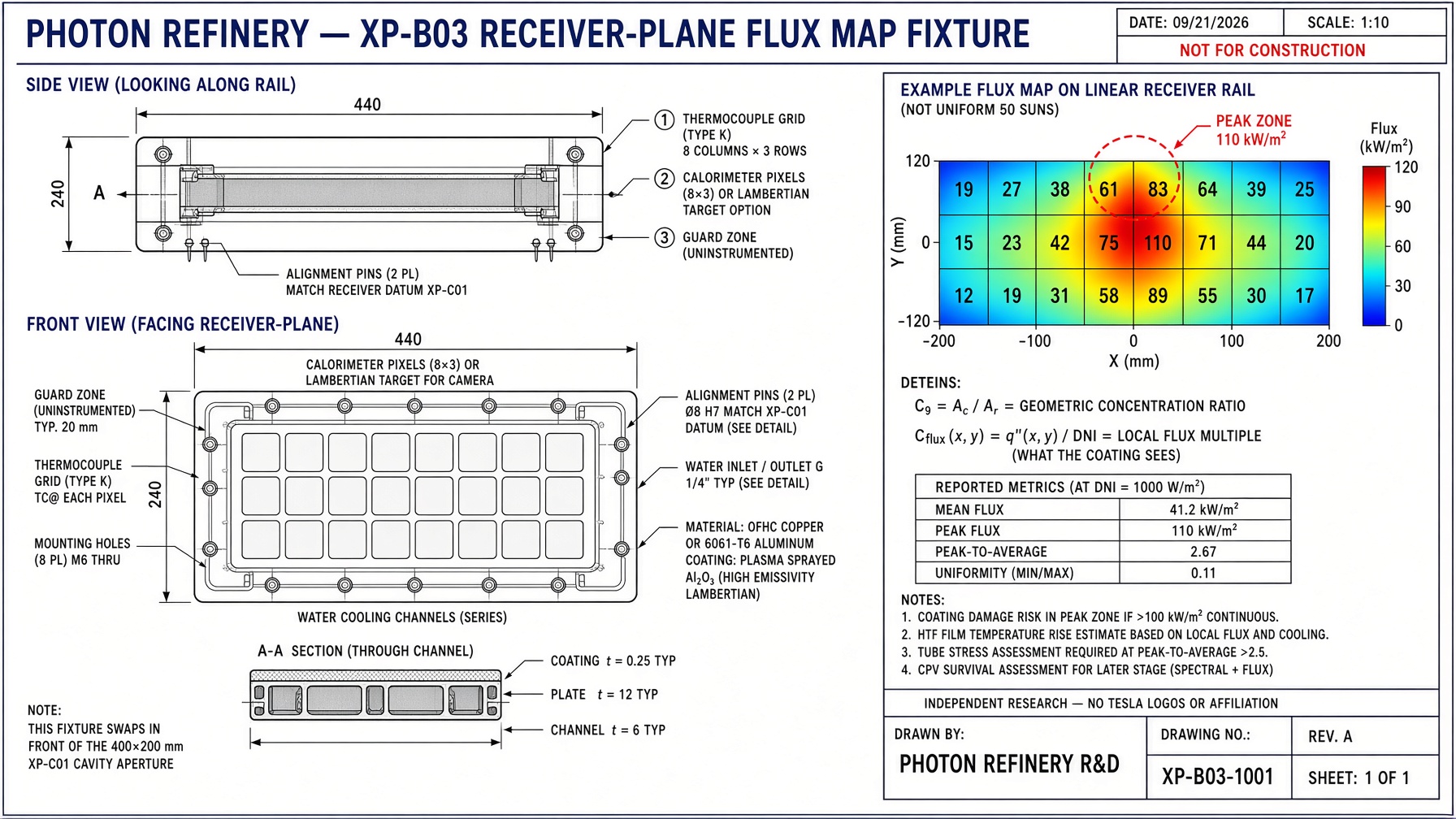
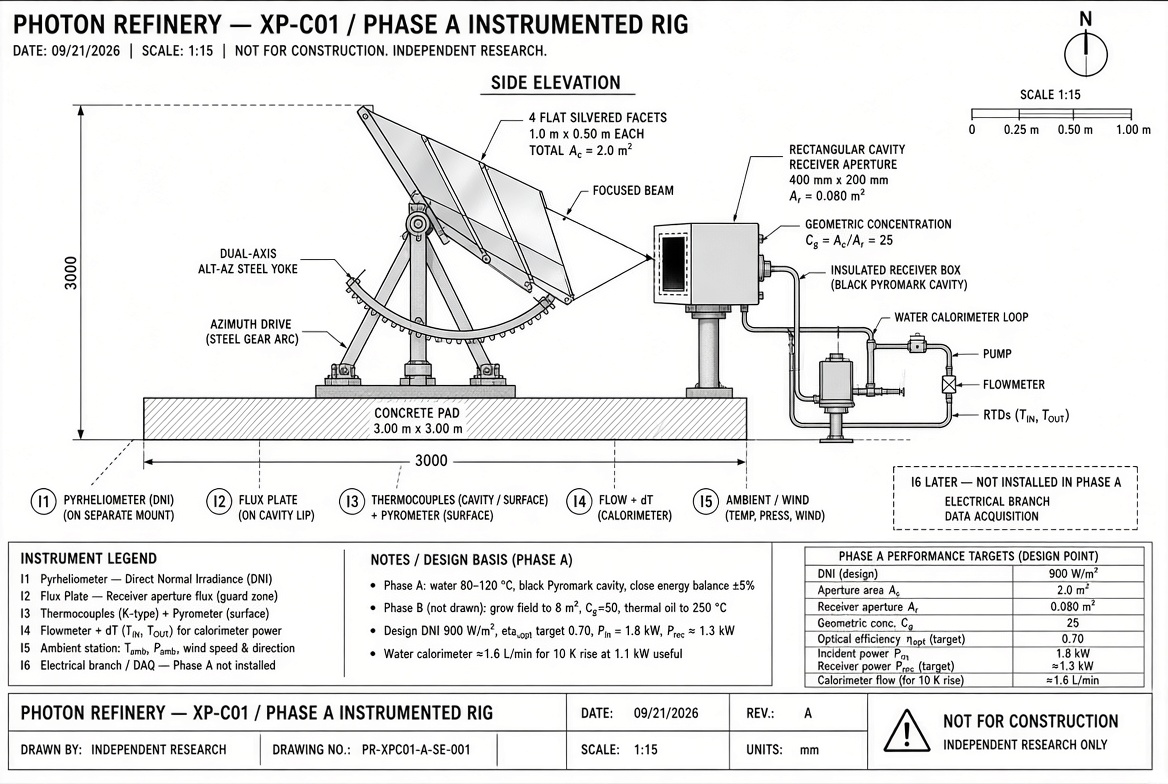
Product is dispatchable Class-M heat, not LCOE versus PV. Cg sizes the aperture. C_flux is what the coating sees. G0 is a 5% closure with an uncertainty budget. M4 sets acres. LCOH is $/MWh_th delivered.

Locked in Rev C

Decisions that can be wrong in public

PR-C01

Optics

Compact linear Fresnel, 40 m² pods, single-axis, secondary CPC. Trough is Option B if Gate G3 kills LFR optically.

Geometry

Concentration

Cg = 50 on the commercial pod. Illuminated receiver area is 0.80 m² per pod — an 8.0 m × 100 mm rail, not a 6-inch hole.

RC-T

First receiver

Class-M thermal oil, 250–390 °C. Absorb and extract only. No TPV, chemistry, or storage at focus.

XP-C01

Prototype

Phase A is 2 m² / 25× / water 80–120 °C. Phase B grows to 8 m² / 50× / oil before any 250 °C claim.

Drawings

Engineering sheets

All sheets

Product

Dispatchable industrial heat at 150–390 °C. Electricity only after it raises whole-system exergy.

Daytime process heat sits in the same cost band as PV plus a heater. Night and multi-hour industrial heat is the wedge: thermal storage is tens of dollars per kWh_th. Do not claim LCOE victory against silicon plus batteries.